
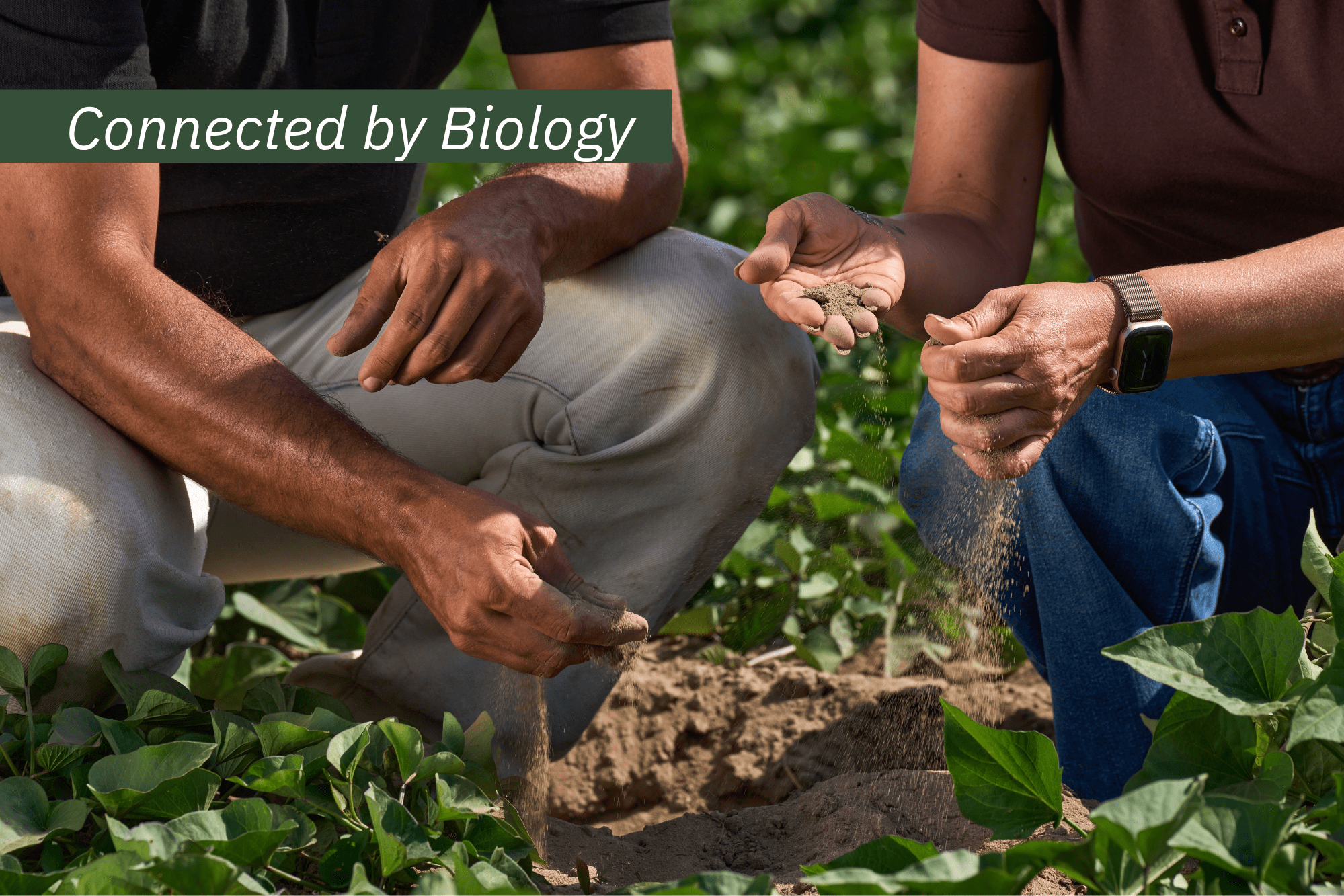
Every agricultural field tells a history of decisions. Over time, how soil is managed determines not only productivity, but also the diversity and stability of the living systems it supports.
Soil biodiversity is not a static thing. It responds directly and continuously to management choices that either reinforce or disrupt biological processes.
Management as a biological driver
Soil disturbance, organic inputs, crop diversity and the presence of living roots all influence soil life at a fundamental level. These crop management decisions shape microbial communities, root environments, and ecological interactions.
Practices such as reduced tillage, the use of cover crops or diversified rotations are increasingly associated with improved soil biological activity and structure.
In systems where the soil remains covered and roots are present for longer periods, microbial activity tends to stabilize, organic matter is better preserved, and soil structure becomes more resilient.
Over time, this can translate into more consistent water infiltration, improved root development and greater system stability — particularly under variable conditions.
In contrast, repeated disturbance and low organic inputs often reduce biological diversity and hinder system function over time.
These changes are rarely immediate, but they accumulate season after season, defining how the system behaves.
In practice, this means that management decisions do not just affect crops — they define the biological environment on which those crops depend.
Biological continuity matters
Living systems depend on continuity. When soil is frequently disturbed, biological networks — from microbial communities to soil fauna — struggle to stabilize.
This has consequences: nutrient cycling becomes less efficient, soil structure weakens and the system becomes more sensitive to stress.
Continuity, ensured through practices such as reduced disturbance, permanent or seasonal cover, and sustained root presence, allows biological networks to remain active over time. This stability is what supports consistent soil function, from nutrient cycling to water regulation.
It is not only about increasing biodiversity, but about keeping it functional.
Scale does not limit impact
Soil management decisions are made locally, field by field, but their impact extends far beyond individual plots.
Across different regions and systems, similar patterns emerge: Where soils are repeatedly disturbed and simplified, biological activity declines and structural degradation becomes more likely; where continuity and diversity are maintained, systems tend to retain their function for longer.
Globally, it is estimated that around one third of world agricultural soils are degraded to some degree, often linked to long-term patterns of intensive disturbance, low organic matter incorporation and simplified cropping systems. At the same time, there is growing evidence that regenerative approaches can help restore biological activity and improve soil function over time.
This highlights an important point: small, repeated crop management decisions have a long-term impact.
From practices to processes
Effective soil management is not only about applying specific techniques, but about understanding how those techniques influence biological processes. When we move from managing inputs and stop asking “What input should be added”, to managing systems and start asking “How does the system respond”, measurable changes occur, including:
- gradual increases in soil organic matter
- improved soil structure and aggregation
- more stable water infiltration patterns
- higher and more consistent biological activity
This perspective brings soil biodiversity into the core of decision-making, not as an objective in itself, but as a condition for system performance.
Managing with the system
Recognizing soil as a living system changes how decisions are framed. Crop management becomes less about controlling variables in isolation, and more about shaping interactions between soil, plants and biology.
This approach does not remove complexity — it works with it.
And in doing so, it creates the conditions for systems that are more resilient, more efficient and better aligned with the conservation of living resources.
Want to learn more? Explore these resources
- Food and Agriculture Organization of the United Nations (FAO) — Status of the World’s Soil Resources
- Food and Agriculture Organization of the United Nations (FAO) — Conservation Agriculture
- European Commission — Soil Strategy for 2030
This article is part of the Connected by Biology series, exploring the living systems behind agriculture.
→ Next: Resilience starts in the soil — biodiversity in a changing climate