
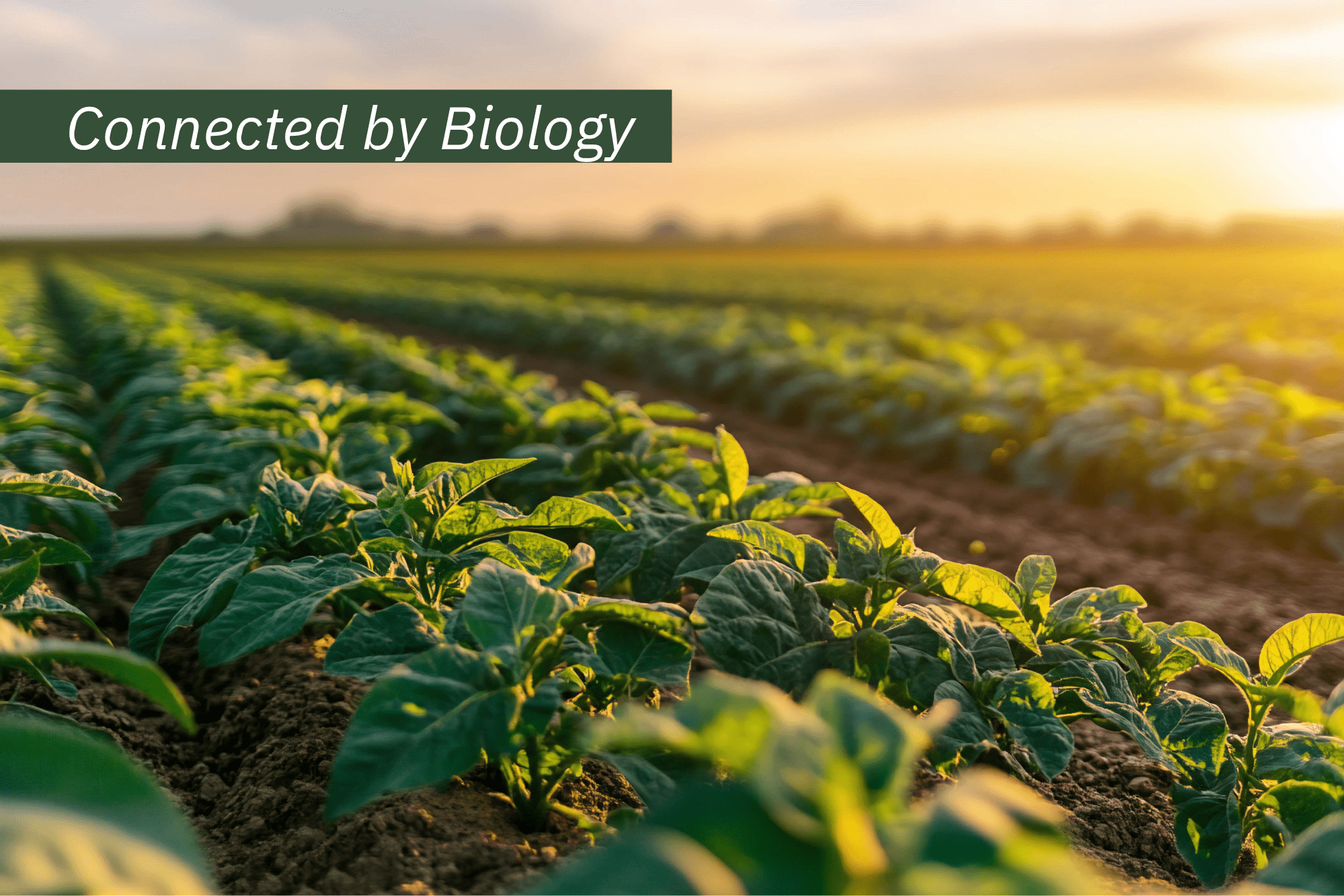
Across the globe, agriculture is increasingly shaped by variability. While in one part of the world, crops struggle under prolonged heat and water scarcity, in another, intense rainfall leads to saturated soils, runoff and erosion.
Different conditions, same question: how does the system respond under changing climate stress?.
Yet even within the same landscape, responses are not uniform. Two neighbouring fields, exposed to identical weather conditions, can behave very differently. In one, water is quickly lost through runoff or evaporation. In the other, it infiltrates, is retained, and supports plant growth for longer.
These differences are not random. They reflect how the system functions below the surface — and more specifically, how the biological processes within that system are, or are not, able to sustain key functions when conditions become difficult.
Resilience is a system property
Agricultural production is often shaped by decisions that focus on individual factors rather than how the system functions as a whole. Increasingly, it is becoming clear that this fragmented approach plays a role in how systems respond, or fail to respond, under pressure.
Resilience is not defined by a single factor, nor built in a single season. It develops over time, shaped by the conditions the soil is given to operate in, and by whether the biological processes within it are supported or progressively disrupted.
When biological activity is sustained, key processes, such as organic matter transformation, aggregation and nutrient cycling, maintain a level of functionality that influences how the system responds under stress. This is the distinction between a soil that has structural and biological capacity, and one that does not.
That capacity affects how water moves through the soil, how it is stored, and how consistently plants can access it. Under dry conditions, moisture loss can be slower. During intense rainfall, infiltration can improve, reducing runoff and soil loss. In periods of fluctuation, these processes help stabilise how the system functions.
These are not isolated effects. They are expressions of a system that retains the capacity to function as conditions change.
Functionality beyond presence
Soil biodiversity is often reduced to how much life is present. But in practice, its relevance lies in how consistently the system can function when conditions are no longer stable.
What matters is not only diversity itself, but what that diversity makes possible. Systems supported by a broader range of biological interactions, across bacteria, fungi, and the organisms that interact with them, tend to maintain key processes through multiple pathways rather than depending on a single one. When one pathway is disrupted by drought, heat, or waterlogging, others can compensate. Decomposition continues. Aggregates are maintained. Nutrient cycling does not stop.
This becomes particularly relevant under increasing variability. When conditions shift between excess and scarcity, the system is less dependent on one dominant response and more able to sustain function across a wider range of scenarios.
In this context, resilience is not about preventing stress. It is about avoiding functional gaps when stress occurs.
Systems with reduced biological complexity may perform efficiently under predictable conditions. But as variability becomes more frequent and less predictable, the ability to maintain function, rather than simply perform under ideal conditions, becomes the defining factor.
Responding to variability
Climate pressure does not act in a single direction. It introduces variability, shifts between excess and scarcity, often within the same production cycle, and it is precisely at these extremes that the condition of the soil becomes most consequential.
Under intense rainfall, where structure is limited and biological processes are constrained, water moves rapidly across or out of the system, carrying soil and nutrients with it. Where structure is stable and processes are active, infiltration improves, storage increases, and losses are reduced.
Under prolonged dry periods, the same distinction applies. Soils with limited organic matter and reduced biological activity lose water quickly, shortening the window in which crops can function without stress. Soils with greater biological capacity tend to buffer that effect, maintaining moisture availability for longer.
The differences between these two scenarios are not marginal. And they are consistently observed, even if they only become fully visible when conditions push the system toward its limits.
Created, not added
Resilience is not an input. It cannot be applied when needed.
It is the result of how the system is managed over time: how disturbance is balanced, how soil cover is maintained, how organic matter is returned, and whether biological processes are allowed to operate continuously. But it is also the result of what is avoided — practices that fragment soil structure, reduce biological diversity, or interrupt the cycles on which these processes depend.
These choices, what is done and what is not done, shape the conditions under which the system either develops resilience or loses it.
From this perspective, resilience is not a separate objective from productivity. It is part of what sustains it, across seasons, and across the variability that is increasingly defining them.
And it starts in the soil.
Want to learn more? Explore these resources
- FAO — Soil biodiversity and ecosystem services
- FAO — State of Knowledge of Soil Biodiversity (2020)
- Nature Scientific Reports — Soil organic carbon and drought resilience
This article is part of the Connected by Biology series, exploring the living systems behind agriculture.
→ Next: Knowledge and innovation: Working with biology, not against it.