
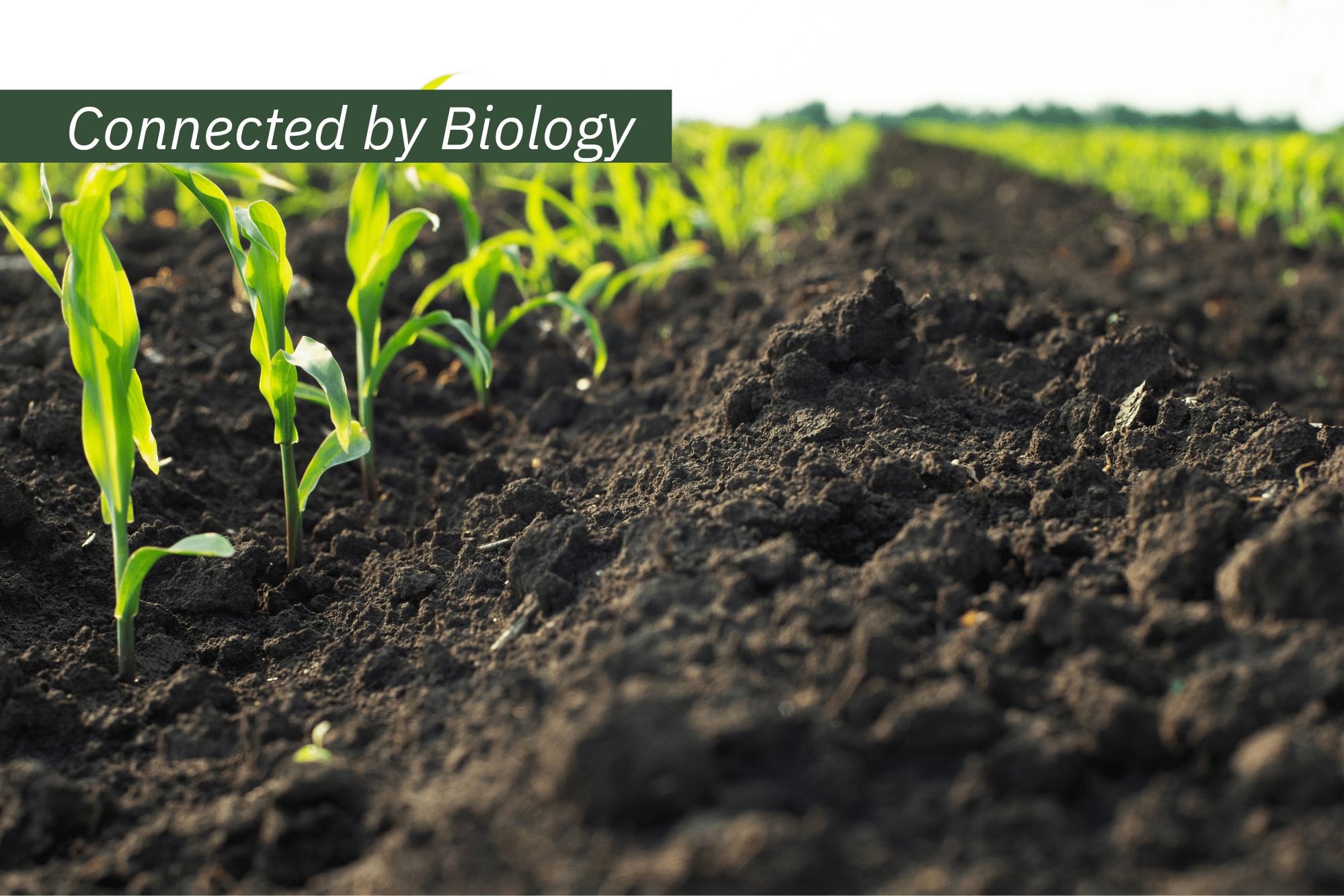
Why the future of agriculture depends on the continuity of life beneath our feet.
(After seven articles exploring the biological connections that shape agricultural systems, this World Day for Soil Conservation feature brings together scientists, agronomists and field specialists to reflect on the living processes that sustain soil function and agricultural resilience.)
Most of what determines agricultural success cannot be seen.
When we walk through a field, our attention naturally goes to what is visible: crop vigor, weather conditions, the color of the leaves, or the quality of the harvest. Agricultural progress has also long been measured through what happens above ground: higher yields, improved genetics, more efficient fertilizers, and increasingly precise crop management.
Yet every one of these achievements depends on an equally complex system beneath our feet, where billions of microorganisms interact with plant roots, fungi, insects, and countless other organisms, forming a biological network that regulates nutrient cycling, water dynamics, plant health, and the capacity of crops to respond to stress.
Nicolas Body, technical manager for Alltech Crop Science Europe, illustrates this concept through a simple comparison: just as humans depend on a healthy gut microbiome to transform food into usable nutrients, plants depend on an equally complex living community beneath the soil.
In his own words, “Plants are alive when the soil is alive.”
This simple observation reflects a profound shift in agricultural science. For decades, soil has been understood primarily through its physical and chemical properties. Texture, pH, structure, organic matter, and nutrient availability remain essential indicators of soil quality. However, research increasingly shows that these characteristics only tell part of the story.
Researchers, soil scientists, agronomists, and agricultural specialists may approach soil from different perspectives, yet they converge on a shared understanding: the future of agriculture depends not simply on improving individual components of production but on understanding the biological relationships that connect them.
The focus shifts from soil as a resource to soil as a living system.
More than the sum of its parts
Perhaps the greatest misconception about soil is not that it has been overlooked, but that it has too often been understood in pieces.
Modern agriculture has become exceptionally proficient at measuring individual components. Researchers can analyze nutrient concentrations, pH, organic matter, pathogens, and water availability with remarkable precision. Each provides valuable information, yet none fully explains why one soil consistently produces healthy, resilient crops while another, despite apparently similar characteristics, performs very differently.
Professor Carlos García-Izquierdo, research professor at CEBAS-CSIC (Murcia, Spain), has spent decades studying soil as a living ecosystem rather than simply a growing medium. In his view, soil is “the setting for countless biological processes that sustain life, where microorganisms, organic matter, roots, and soil fauna interact continuously to maintain essential ecological functions.”
This perspective also expands our understanding of productivity. Nutrients are transformed through biological activity, water is regulated through interactions between structure and organic matter, and plant health depends as much on functional biological communities as on the absence of pathogens.
Professor Carlos Alexandre Costa Crusciol, from São Paulo State University (UNESP, São Paulo, Brazil), highlights soil as a dynamic ecosystem where microorganisms, fauna, and organic matter regulate nutrient cycling, soil structure, and water dynamics. Biodiversity is therefore one of the mechanisms through which agricultural systems function.
Seen this way, biology does not replace chemistry or physics. It connects them.
Yet, despite rapid advances in soil microbiology, much of this biological activity remains underestimated in practice. As Professor Crusciol observes, “The functional role of microbial communities is still less visible in agricultural decision-making than their importance would suggest.” What cannot easily be observed is often assumed to play a secondary role in management decisions.
The question is no longer simply how fertile a soil is, but how effectively its biological processes make that fertility available to plants.
As Rui Amante, strategic marketing manager for Alltech Crop Science Iberia, points out, crop nutrition depends as much on “maintaining the biological activity that transforms them into forms plants can use efficiently,” as on supplying nutrients.
Understanding soil requires a fundamental shift in perspective: rather than optimizing individual components, agriculture increasingly seeks to strengthen the biological relationships that allow the whole system to function.
A conversation beneath our feet
One of the greatest advances in soil biology has been the growing understanding that plants and microorganisms do not simply coexist. They communicate continuously, influencing nutrition, growth, resilience, and environmental stress response.
The rhizosphere—the narrow zone surrounding plant roots—is one of the most biologically active environments on Earth. Here, plants release a complex mixture of carbohydrates, amino acids, and other compounds that attract, stimulate, or discourage different microbial communities, actively shaping the biological environment in which they grow.
Gabriel Tosetti, market development manager at Alltech Crop Science Brasil, summarizes this shift in understanding with a simple but powerful observation: “Plants don’t passively receive their microbiome. They recruit and modulate communities.”
That statement challenges a long-held belief. Research increasingly demonstrates that plants do not simply adapt to the microbiome. They actively shape it throughout their life cycle.
Those biological partnerships are also dynamic. Drawing on his experience in market development at Alltech Crop Science Brasil, Matheus Medeiros explains this process of biological adjustment as “plants continuously adjusting their interactions with soil microorganisms in response to changing conditions, making the rhizosphere an environment of constant communication and adaptation”.
Plant health is no longer determined solely by genetics or crop management. It also depends on the quality of the biological relationships developing beneath the surface.
A healthy soil cannot be defined solely by nutrient availability or pathogen pressure. It is one where biological interactions remain active, diverse, and balanced.
Professor García-Izquierdo often approaches biodiversity from exactly this perspective. Its importance lies less in the number of organisms present than in the ecological functions they collectively perform. Different microorganisms contribute to nutrient cycling, organic matter decomposition, aggregate formation, and natural disease suppression, creating a system that is far more capable of adapting to change than any individual organism could achieve alone.
The result is a more resilient agricultural system, not because it eliminates variability, but because it is better equipped to respond to it.
Every field remembers
If biological relationships are constantly evolving, they are also constantly being shaped by management.
Every crop grown, every tillage operation, every addition of organic matter, and every period of bare soil influences the biological communities living beneath the surface. Some changes occur quickly. Others may only become visible after years of repeated decisions.
In that sense, soil carries a biological memory.
Tosetti captures this idea when he states that “soil is an individual with memory.”
Biological communities develop gradually, responding to the conditions created over successive seasons of practices such as crop rotation, permanent soil cover, diversified root systems, and regular organic matter inputs.
Healthy soils do not emerge from isolated biological inputs. They develop when management consistently supports the living systems already present.
Professor García-Izquierdo’s work repeatedly points to this long-term perspective. Reducing disturbance, maintaining organic matter and increasing plant diversity are not independent objectives. Together, they support soil biological activities.
Body reaches a remarkably similar conclusion from years of technical work with farmers across Europe. Healthy soils depend on excellent agronomic practices, and biological technologies work best when they complement them.
Whether viewed through long-term ecological research or practical agronomy, the conclusion remains the same. Healthy soils emerge from management systems that strengthen, rather than disrupt, biological relationships.
Biologically active soils store water more effectively, cycle nutrients efficiently, support stronger root systems, and recover more rapidly from disturbance.
Professor García-Izquierdo introduces another concept that captures this beautifully: functional redundancy. Within diverse biological communities, different organisms may perform similar ecological functions. If environmental conditions reduce one population, others can continue cycling nutrients, decomposing organic matter, or supporting plant health.
Resilience, therefore, is not simply the ability to resist change. It is the capacity to continue functioning despite change.
Perhaps that is why biodiversity matters so profoundly. Not because diversity is an objective in itself, but because it allows biological processes to continue.
Continuity
An important lesson is emerging from modern soil science.
Healthy soils are defined not only by what they contain, but by what they continue to do. They cycle nutrients, regulate water, support biodiversity, suppress disease, and enable crops to adapt to changing conditions. These functions are not independent; each relies on countless biological interactions continuously taking place beneath the surface.
It is no longer only about protecting a finite natural resource; it is about safeguarding the biological processes that make that resource productive, resilient, and capable of sustaining future generations.
Researchers described ecosystems whose stability is based on biological variety and functional linkages. Agronomists considered management decisions with long-term consequences. Field experts discussed developing circumstances in which life may recover, establish itself, and continue to operate.
Different perspectives. One shared understanding.
Soil develops over decades, sometimes centuries. Its biological communities are shaped gradually through countless interactions between climate, vegetation, microorganisms, and human management. Every season contributes to that history, and every management decision influences what comes next.
This is why soil can be understood as a form of living heritage.
Francisco Pérez Zunino, iberian technical manager at Alltech Crop Science, expresses this responsibility in a single sentence: “Soil is not an inheritance but a legacy we must leave to our grandchildren.”
Medeiros frames the same responsibility as a question: “What kind of soil would we like to leave our grandchildren? Soil that is rich, suppressive, and productive—or one that is poor and infertile?”
Together, these two reflections point in the same direction.
The future of agriculture will not be shaped only by the technologies we develop or the inputs we apply. It will also depend on our ability to understand, protect, and strengthen the biological relationships that have always sustained life beneath our feet.
This article opened with a simple observation: “Plants are alive when the soil is alive.” By the end of these conversations, that idea carries an even broader meaning. If agriculture depends on living soils, then safeguarding those soils means safeguarding the continuity of the biological processes that keep them alive.
At its core, safeguarding our soils means safeguarding the continuity of the living processes that make agriculture possible.
Missed any part of the Connected by Biology series? Explore the full collection:
- Article 1 — Soil health: The invisible foundation of biodiversity
- Article 2 — Life in the soil: The role of the soil microbiome in agricultural systems
- Article 3 — Interactions alive: how soil, plants, and insects function as one system
- Article 4 — Local decisions, lasting impacts — how soil management shapes biodiversity
- Article 5 — Resilience starts in the soil: Biodiversity in a changing climate
- Article 6 — Knowledge and innovation: working with biology, not against it
- Article 7 — Conserving soil is conserving life — science, responsibility and the future of agriculture