

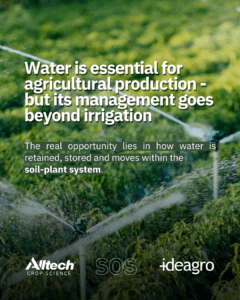
In farming, water is often seen as an input applied, measured and managed through irrigation systems. But this perspective only captures part of the picture.
In reality, water efficiency begins long before irrigation. It starts in the soil.
Not just a question of water — a question of efficiency
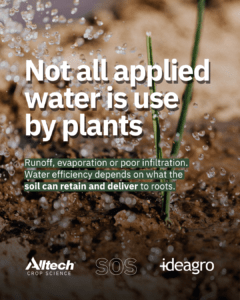
Water is an essential resource for agricultural production, but in many systems, part of the applied water may not be fully utilized by plants. This can be due to factors such as runoff, evaporation or limitations in infiltration.
The key to combating this lies in improving how water is retained, stored and used within the soil–plant system — increasing the proportion of water that is retained in the soil and made available to roots. In this context, it is less about adding more water and more about understanding the system that manages water movement and storage.
That system is the soil.
From irrigation to integration
Traditional approaches to water management have focused on optimizing irrigation — improving timing, delivery systems and application rates. While these remain important, they are only part of the solution.
A more integrated approach considers soil health and how it influences:
- Water infiltration into the soil
- Water storage capacity in the soil
- The release rate of water to plants
- The plant’s ability to access available water
Improving water efficiency starts with improving these processes — and they are all rooted in the soil.
Soil: The original water management system
Soil is often described as a physical medium when, in reality, it works as a dynamic system that controls water infiltration, storage and release.
Soil structure strongly influences how efficiently water penetrates the soil profile and how long it remains available to plants. Well-structured soils allow water to move into the profile more effectively, reducing surface losses and improving availability over time.
The soil’s ability to retain water is just as important. Soil-holding capacity is a key factor in plant growth and water availability and is closely linked to organic matter content and aggregation. Soils with higher levels of organic matter tend to hold more water and release it more gradually, supporting crops during periods of limited rainfall or drought.
Organic matter acts like a sponge within the soil matrix: It increases the number of micropores, helping to create a more stable structure that improves the soil’s capacity to absorb and slowly release water. These aggregates are not purely physical; they are built and stabilized through biological activity — roots, fungi and microorganisms that produce binding compounds and form complex networks in the soil.
The invisible drivers beneath the surface
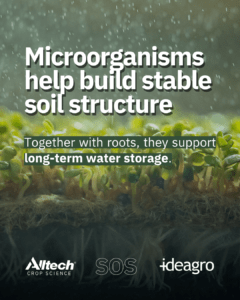
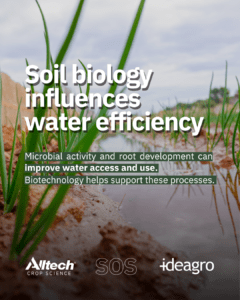
Soil microorganisms contribute to the formation of stable aggregates, improving porosity and enhancing both infiltration and retention. Bacteria and fungi interact with organic residues and root exudates, breaking them down and transforming them into more stable forms of organic matter that support long-term water storage. Mycorrhizal fungi extend the effective root system, accessing water in smaller pores and at greater distances from the root surface.
At the same time, root systems act as the interface between soil and plant, determining how effectively the available water can be accessed. Healthy, well-developed root systems can explore a larger soil volume, increasing access to water reserves. In parallel, biologically active soils that are rich in microbial diversity and root–microbe interactions tend to support more resilient plant systems, better able to cope with periods of water stress.
In this context, microbial inoculation (the targeted introduction of beneficial microorganisms) can complement existing soil communities by stimulating aggregation, enhancing root growth and improving the efficiency with which plants use stored water. When aligned with good soil management, these inputs help reinforce the natural soil functions that underpin water regulation.
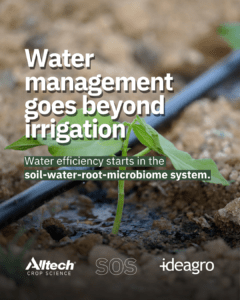
A single, interconnected system is made up of soil, water, roots and microorganisms.
Water efficiency, therefore, cannot be discussed in isolation.
Rethinking water from the ground up
Reframing water as part of a system, rather than as a standalone input, has important implications.
It shifts the focus from applying more water to using it more effectively. It highlights the role of soil as a central component of water management. And it reinforces the idea that resilience in agriculture is built from the ground up.
Protecting water resources begins with protecting the soil.
Because keeping water where it matters is just as important as applying it.

Further readings
#SOS platform
- Water section – Safeguard Our Soils
- Soil section – Safeguard Our Soils
- Beneath the surface: Discovering the invisible network that sustains our food system – Safeguard Our Soils